The Best Sunset in Tuscany — and It’s Not in Florence
This is a bold claim. Tuscany is full of extraordinary sunsets — the region has been producing them for millennia and has become justifiably famous for the quality of its evening light. The cypress-lined roads of the Val d’Orcia at golden hour are practically a religion. The view from Fiesole over Florence as the city turns amber is genuinely stunning. San Gimignano’s towers against a rose-colored sky have appeared on more postcards than most countries produce in a decade.
So when someone who lives in Cortona tells you that the best sunset in Tuscany is from a hilltop above this particular town — it is worth understanding why.
What Makes a Tuscan Sunset Extraordinary
Before the specific argument for Cortona, it is worth understanding what makes any Tuscan sunset exceptional — because the region does produce light of unusual quality and it is not entirely accidental.
Tuscany sits at a latitude and altitude that produces a specific quality of late afternoon light — warm, horizontal, and golden in a way that is related to the angle of the sun and the particular atmosphere of the region. The agricultural landscape — the patchwork of cultivated fields, olive groves, and vineyards that covers the valleys and hillsides — catches and reflects this light in a way that multiplies it, so that the entire landscape seems to glow from within rather than being illuminated from outside.
The hilltop towns add elevation. From a high point above the valley, you see this glowing landscape spread out below you in three dimensions — not a view but an immersion, with the light working simultaneously on the foreground, the middle distance, and the horizon.
This is the Tuscan sunset in its best form. And the question is simply: from which hilltop does it appear most fully?
The Case for Cortona
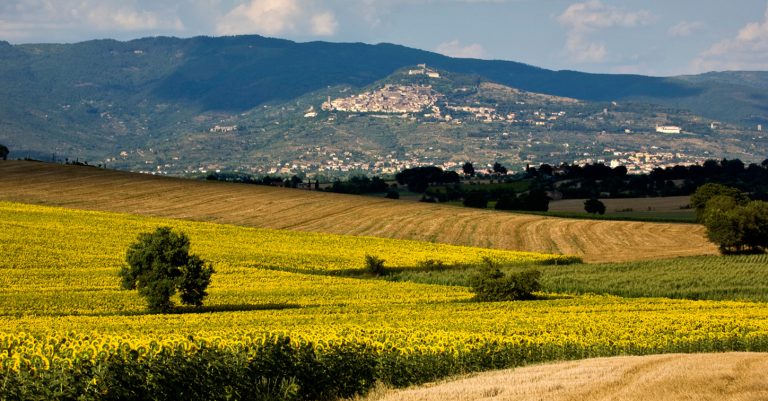
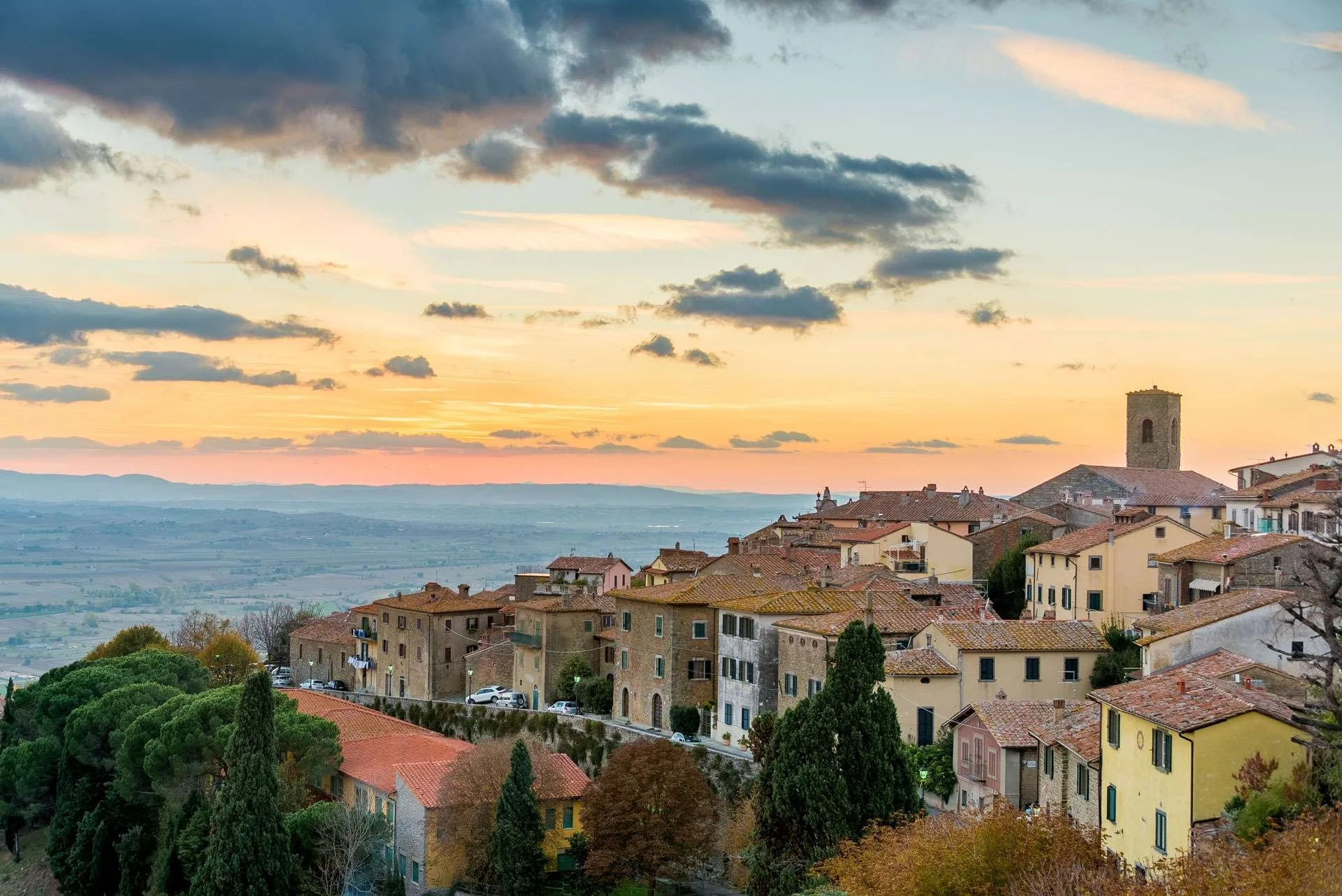
Cortona sits on the eastern edge of Tuscany, on a hill that rises steeply from the Val di Chiana — the broad agricultural valley that runs from Arezzo in the north toward the border with Umbria and Lazio in the south. The town faces west and southwest, which means it faces directly into the setting sun.
Below the town, the Val di Chiana spreads out in the flat, geometric pattern of centuries of agricultural management — fields and farms and the occasional farmhouse, the whole thing bathed in the late afternoon light that comes in low and golden from the west.
To the south, Lake Trasimeno — the largest lake in central Italy — sits on the edge of visibility, silver and still on calm days, its surface catching the light in a way that adds a luminous focal point to an already extraordinary view.
And beyond Lake Trasimeno, on the clearest days — most common in late autumn and early spring — the hills of Umbria are visible. Three regions in a single view: Tuscany, and beyond its border, Umbria, with Lazio somewhere further in the distance.
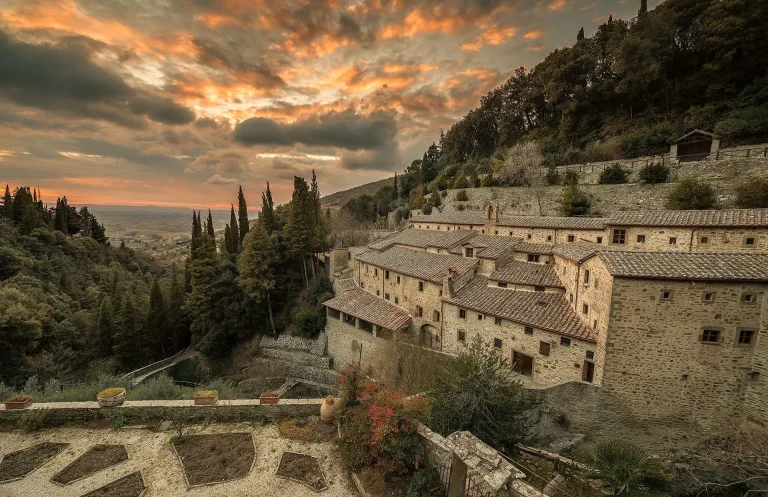
The Etruscan walls provide the foreground. Ancient stone, warm in the evening light, the scale of it adding something that a purely natural viewpoint cannot — the sense that human beings have been standing on this hill watching this light for a very long time.
The Specific Place
The most extraordinary sunset views from Cortona are available from two locations, both in the upper town and both free to access.
The Etruscan walls near the Fortezza Medicea: The highest accessible point in the town, the area around the Fortezza Medicea provides a 270-degree panorama that includes the full breadth of the Val di Chiana, Lake Trasimeno, and on clear days the hills beyond. The Etruscan walls here are well-preserved and provide natural seating — flat sections of ancient stone that have been used for exactly this purpose, presumably, for centuries.
Arrive at least thirty minutes before sunset. The light begins to change significantly in the hour before the sun actually reaches the horizon, and the most extraordinary moments are often in the twenty minutes before sunset rather than at the moment of sunset itself.
The viewpoint above Via Janelli: Less visited than the area around the fortress, the small terrace above Via Janelli in the upper residential quarter provides a view that is slightly different in angle — more directly south toward Lake Trasimeno — and almost always completely empty of other visitors.
This is the view that does not appear on travel blogs. It requires knowing to look for it and a willingness to walk uphill through residential streets without a destination sign to follow. The reward is a sunset view over one of the most beautiful valleys in Italy, with absolute solitude.
The Wine
The argument for Cortona’s sunset is not purely visual. It is also about context.
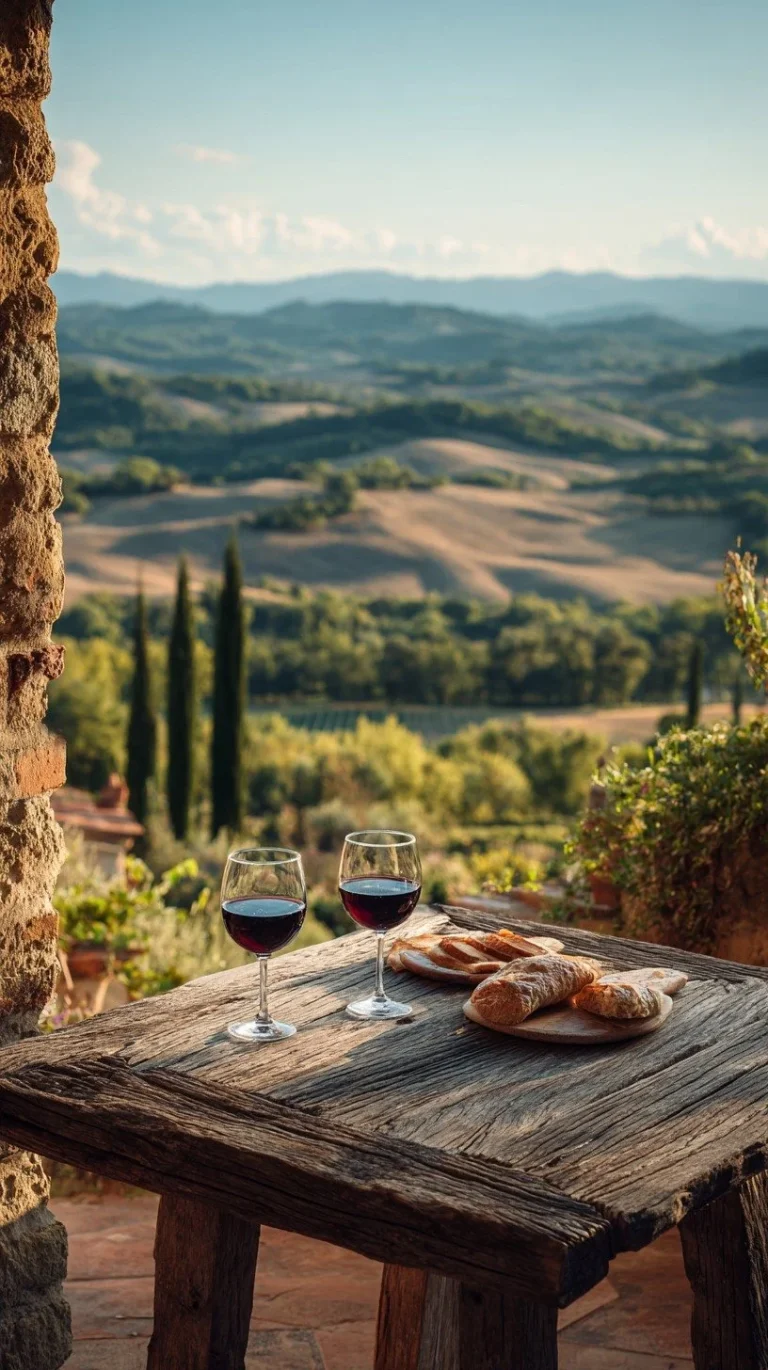
A glass of wine from a Cortona DOC producer — made from grapes grown in the valley you are looking at — in your hand as the light changes over that same valley: this is not incidental to the experience. It is part of it.
Cortona has its own DOC wine appellation, established in 1999, producing Syrah, Sangiovese, and several other varieties from vineyards on the slopes below the town. The wine is made by people who can see, from their vineyard, the hill you are sitting on. This specificity — the direct, traceable connection between the land below you and the glass in your hand — adds something to the experience that imported wine, however good, cannot provide.
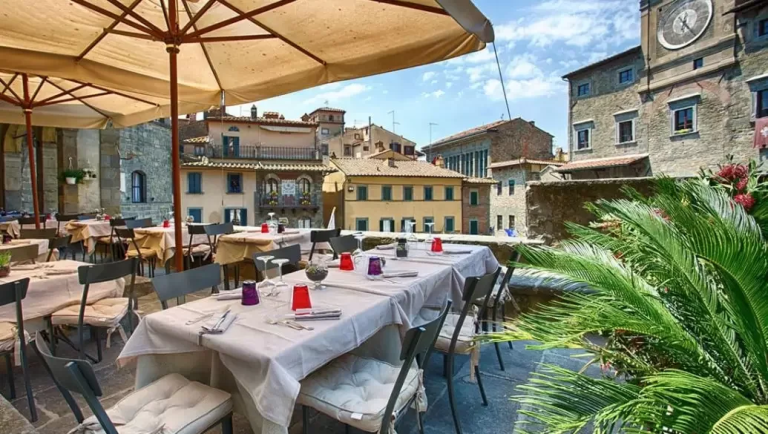
Several bars and enotecas in the upper town will sell you a glass of local wine to take to the walls. This is not officially encouraged and not officially prohibited. It is simply what people do.
When to Go
Season: The most extraordinary sunsets in Cortona occur in autumn — October and November — when the harvest is over, the air is clear, and the low angle of the sun produces the most intense golden light. Late spring — April and May — is the second best period.
Summer sunsets are beautiful but hazy — the heat of the day leaves atmospheric moisture that softens the light and reduces visibility. The lake and the distant hills disappear into the haze. Still beautiful. Not the best.
Winter sunsets can be extraordinary on clear days — the absolute clarity of cold air, the low sun, the bare vines and olive trees in the valley — but they are less reliable and the cold on the walls is significant.
Time: Arrive thirty to forty-five minutes before sunset. Check the sunset time for the specific date — it varies considerably across the year, from approximately 5pm in December to approximately 8:30pm in June.
Day of the week: Any day. The upper town is quiet throughout the week. Weekends bring slightly more visitors to the main areas of town but the walls are never crowded.
Experience the Sunset with MyTuscanDays
A private day in Cortona with MyTuscanDays ends, when the season and conditions allow, at the Etruscan walls as the light changes over the Val di Chiana.
Not because it is on the itinerary. Because it is the right way to end a day in this town — with the ancient stone warm under your hands and the valley below you doing what the Val di Chiana has been doing at this hour, from this vantage point, for as long as anyone has been here to watch it.
MyTuscanDays is Cortona’s leading private experience operator. Every experience is personal, private, and guided by someone who actually lives here.
📍 Cortona, Tuscany, Italy 🧭 Explore Experiences 🧭 Reserve Your Day ✉️ [email protected]