The Spiritual Landscape of Cortona — Etruscan to Franciscan
There are places in the world that have accumulated spiritual significance across multiple traditions and multiple millennia — places where something in the physical environment, the elevation, the silence, the quality of the light, has made them consistently attractive to people seeking contact with something larger than their immediate circumstances.
Cortona is one of these places.
The accumulation begins with the Etruscans, who chose this hilltop as one of their twelve sacred cities approximately 2,700 years ago. It continues through the Roman period, through the medieval Christian tradition, through the specific Franciscan spirituality that Francis of Assisi brought to the hills above this town in the 13th century, and through the continuous religious life of the community that has inhabited this hill without interruption since before the Roman Empire.
To walk the spiritual landscape of Cortona is to walk through time — not as a tourist moving through preserved history but as a person moving through a landscape that is still actively used, still prayed in, still tended by people who understand themselves as part of a tradition that goes back further than most of Western civilization.
The Etruscan Foundation — Before Rome
The Etruscans were a deeply religious civilization. Their entire social and political structure was organized around the interpretation of divine will — through the flight of birds, the examination of animal organs, the observation of lightning and other natural phenomena. They believed that the earth itself was divided into zones of greater and lesser spiritual power, and they built their cities on the points of greatest power — invariably the highest available ground.
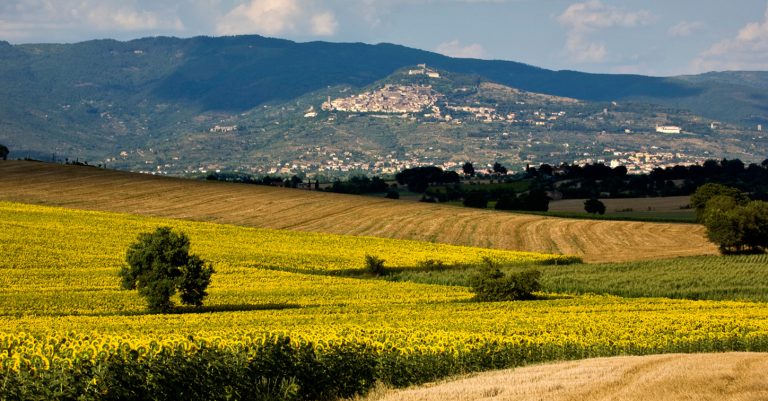
Cortona was one of the twelve cities of the Etruscan League — the dodecapoli — the federation of city-states that organized Etruscan civilization at its height. Its position on a steep hill above the Val di Chiana was not chosen for purely defensive reasons. It was chosen because this hill, in Etruscan understanding, was a place of spiritual elevation in a literal and a metaphorical sense simultaneously.
The evidence of this spiritual life is still visible. The Tumulo del Sodo — the great burial mound just below the hill — is not merely a cemetery. It is a place of active religious practice: the altar on its exterior was used for ongoing ceremonies, offerings, the maintenance of the relationship between the living and the dead that the Etruscans took with extraordinary seriousness. The dead were not removed from the community. They were maintained within it, visited, fed, spoken to.
The MAEC museum holds the material evidence of this spiritual life — the votive objects, the funerary equipment, the sacred vessels. But the physical landscape holds something different: the sense of a tradition of sacred attention to this specific place that predates by centuries everything that came after.
The Christian Continuity
The transition from Etruscan to Roman to Christian Cortona was a transition of form rather than place. The sacred sites of the Etruscan city became, in many cases, the sites of Christian churches — a pattern repeated across Italy as the early Church absorbed and redirected the sacred geography it inherited.
The Duomo di Cortona — the cathedral at the top of the main piazza — sits near the site of ancient Etruscan religious structures. The church of Santa Maria delle Grazie al Calcinaio, just below the hill, is a Renaissance masterpiece built over a site of reported miracle — the kind of site that tends to accumulate sanctity across traditions and periods.
The medieval and Renaissance religious life of Cortona was rich and complex — the town produced saints, supported significant religious orders, and maintained a devotional culture that is visible in every church interior and in the persistence of religious festivals that continue today in attenuated but recognizable form.
Francis of Assisi — The Franciscan Dimension
The most significant addition to the spiritual landscape of Cortona was made not by a Cortona institution but by a traveler who came to the hills above the town seeking exactly what those hills offered: solitude, silence, and the specific quality of a place that has accumulated the attention of people seeking contact with the sacred.
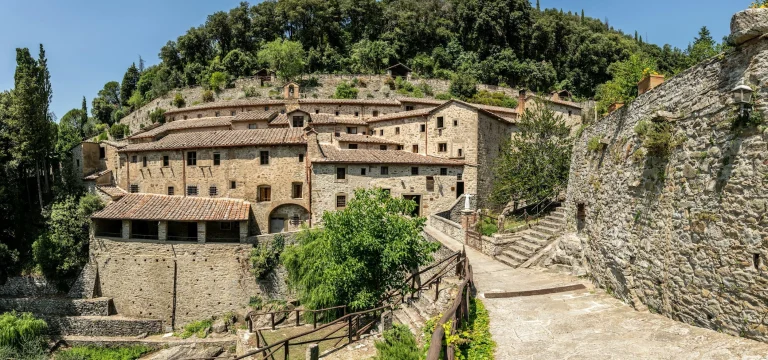
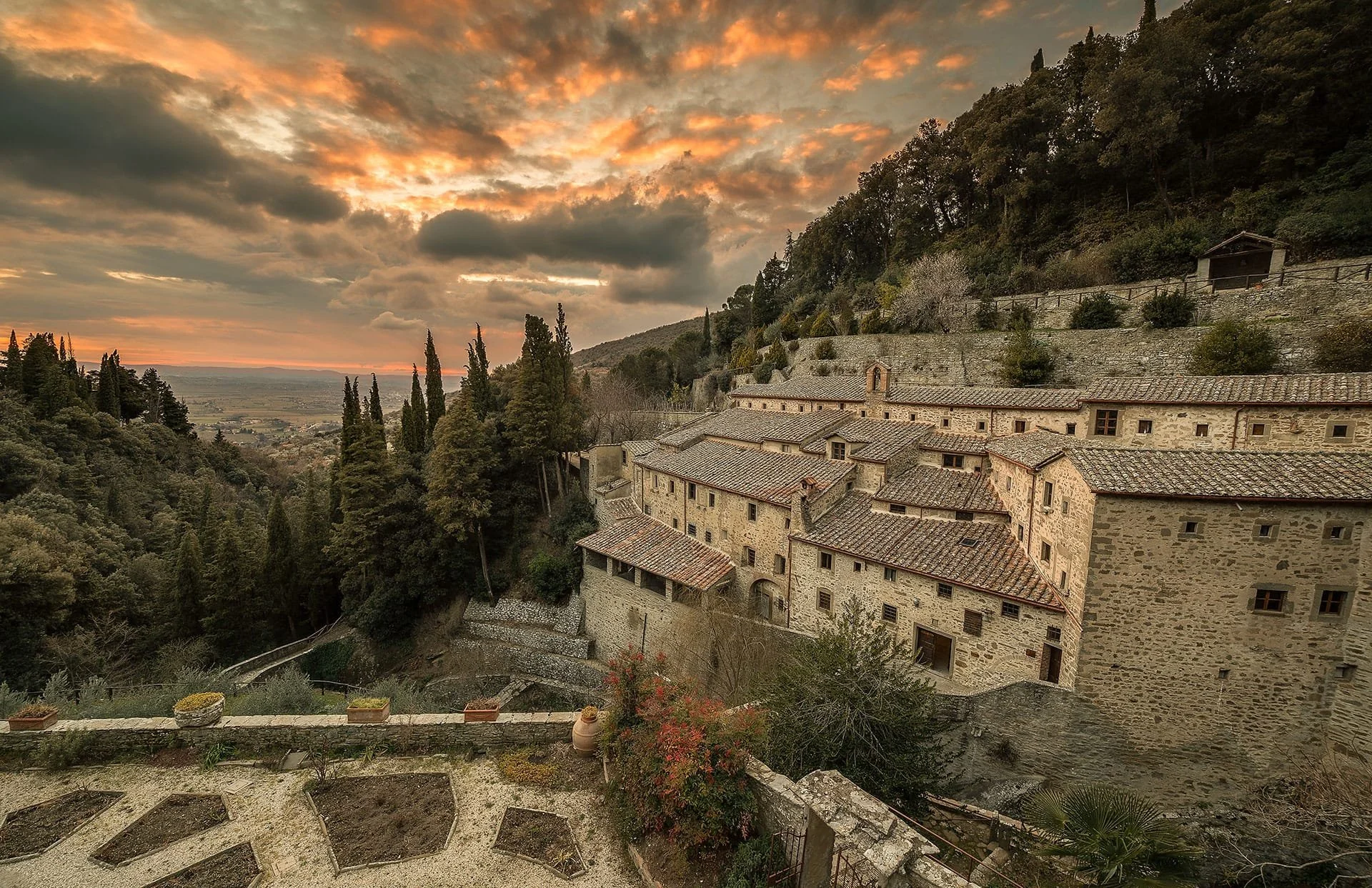
Francis of Assisi came to Le Celle — a narrow ravine in the hills above Cortona, above a rushing mountain stream — before his movement had become famous, before the order he founded had grown into the global institution it became, before Assisi had been transformed by his presence into the pilgrimage center it now is.
He came here to be alone. To pray. To hear something that the noise of the world made inaudible.
He came back repeatedly. The hermitage at Le Celle — cells carved into the cliff face above the stream, the sound of water constant, the sky a strip above the ravine — gave him something that no other place gave him in quite the same way. Scholars who have studied the geography of Francis’s spiritual life understand Le Celle as one of the formative places of his inner development.
The hermitage he used is still there. It has been maintained continuously for 800 years by Franciscan friars who live there today according to the same rule he established. The cave where he prayed is still accessible. The stream still runs. The silence still has the specific quality that drew him there.
The Living Tradition
What makes the spiritual landscape of Cortona distinctive is not its antiquity — many places in Italy are ancient. It is the fact that the traditions it has hosted are still alive.
The Franciscan friars at Le Celle are not curators of a monument. They are monks living a vowed life of prayer in a place that has been used for exactly that purpose for 800 years. Their daily rhythm — prayer, work, silence, more prayer — is essentially the same rhythm that Francis established in the 13th century.
The religious life of the town continues in forms that are attenuated by secularization but not eliminated. The church bells ring at the canonical hours. The major festivals of the religious calendar are observed. The Madonna della Consolazione in the Duomo still receives visitors who come not as tourists but as petitioners.
The Etruscan sacred tradition is no longer practiced — its practitioners died two millennia ago. But the landscape they consecrated is still there. The walls they built, the hills they climbed, the air they moved through — these persist. And there is something in the accumulated attention of two and a half thousand years of human beings treating this place as sacred that leaves a trace which is difficult to name but not difficult to feel.
How to Walk the Spiritual Landscape of Cortona
A day that takes the spiritual geography of Cortona seriously looks like this:
Begin at the Etruscan walls at dawn — the oldest stratum of the sacred landscape, before the town is awake.
Visit the MAEC museum mid-morning — the material evidence of Etruscan religious practice, giving the walls a human and theological context.
Drive to Le Celle after lunch — arrive when the afternoon is at its quietest. Walk up alongside the stream. Enter the chapel. Sit with the silence.
Return to Cortona for the late afternoon. Find the chiesa of Santa Maria delle Grazie al Calcinaio on the way back up the hill — the Renaissance exterior is a masterpiece and the interior is genuinely beautiful.
End the day with the passeggiata in Piazza della Repubblica — not a spiritual practice in any formal sense, but a community ritual with deep roots in the same cultural soil that produced everything else this landscape contains.
Experience the Spiritual Landscape with MyTuscanDays
The spiritual landscape of Cortona is most fully experienced with context — understanding what each site represents, why it was built where it was built, and what the relationship between the different layers of sacred tradition in this place reveals about the human need for places of contact with the sacred.
MyTuscanDays offers private experiences that engage seriously with this landscape — not as a spiritual tour in any formal sense, but as a day in a place that deserves more than a checklist.
📍 Cortona, Tuscany, Italy 👉 Explore Experiences 👉 Reserve Your Day 📩 [email protected]