The Etruscan Walls of Cortona — Older Than Rome
Rome was founded, according to tradition, in 753 BC.
The Etruscan walls of Cortona are older than that.
This is not a minor historical footnote. It is one of the most remarkable facts about a town that is full of remarkable facts — and it is physically, tangibly available to anyone who walks to the upper part of Cortona and puts their hands on the stone.
No museum. No reconstruction. No interpretive display explaining what you are looking at from a respectful distance behind a barrier.
Just the wall. Just the stone. Just 2,700 years of continuous presence on a Tuscan hilltop.
Who Built the Etruscan Walls of Cortona — and Why
The Etruscans were one of the great civilizations of the ancient world. Between approximately 900 BC and 200 BC they built a network of sophisticated city-states across central Italy — modern Tuscany, Umbria, and northern Lazio — that were among the most advanced urban centers of their time.
Cortona was one of the twelve great cities of the Etruscan League — the dodecapoli — the political and religious federation that organized Etruscan civilization at its height. As one of these cities, Cortona was a place of genuine importance: a center of trade, religious practice, artistic production, and political power.
The walls were built to define and defend this importance.
The construction technique is called cyclopean masonry — a name given by later civilizations who found walls like these and assumed, given the scale of the stones, that they must have been built by giants. The stones are large — some of them enormously so — and they are fitted together without mortar. No binding material. Just stone against stone, placed with such precision and such understanding of how weight and pressure distribute through a structure that the result has stood, without significant restoration, for nearly three millennia.
The engineering knowledge required to select, transport, and place these stones — without machinery, without modern surveying tools, without the accumulated civil engineering knowledge of the Roman period that came later — was extraordinary. The walls are a testament to what a sophisticated civilization can achieve when it has sufficient time, sufficient resources, and sufficient understanding of its materials.
What You Are Looking At
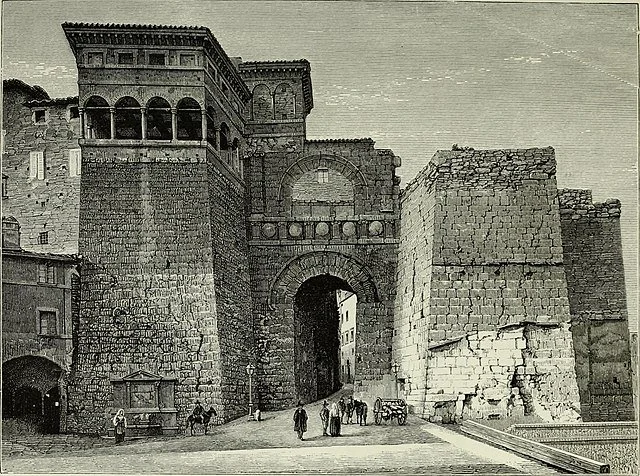
The surviving sections of the Etruscan walls run along the upper ridge of Cortona’s hill, following the natural topography in a way that maximizes their defensive effectiveness while minimizing the volume of stone required.
The walls vary in height depending on their location and preservation — some sections rise to several meters, others have been reduced over centuries of use, reuse, and occasional dismantling for building material. In some places, later construction — Roman, medieval, Renaissance — is visible sitting directly on top of the Etruscan foundation. The history of the town is literally layered in the stone.
The individual stones range from large to genuinely massive. The largest are approximately the size of a small car. Moving them, positioning them, fitting them together with the precision visible in the surviving sections — this was an engineering achievement that commands respect regardless of your interest in ancient history.
Look closely at the joints between stones. The fitting is remarkably precise for unmortared construction — the surfaces where stones meet have been worked to reduce gaps and maximize the contact area that holds the structure together through friction and weight distribution alone. This is skilled work. Sophisticated work. The work of people who understood their material deeply.
The Experience of Touching Them
There is a specific experience available at the Etruscan walls of Cortona that is available at very few other historical sites in the world.
You can touch them.
Not metaphorically. Not through glass. Not from behind a barrier at a respectful distance that preserves the site for future generations at the cost of any present-tense connection with it.
You can walk up to the wall, place both hands flat on the stone, and feel the specific texture of rock that was placed there 2,700 years ago. The mineral cold of it. The slight roughness of worked stone that has been weathered by nearly three thousand years of Tuscan seasons. The weight and solidity of something built to last and still, unmistakably, lasting.
Something happens in this moment that is difficult to describe in advance but immediately recognizable when it occurs. The scale of the time involved — 2,700 years — is intellectually comprehensible but experientially abstract until you have physical contact with something that has persisted across that entire span. The touch makes it real in a way that no amount of reading or looking can replicate.
People stand at these walls and go quiet. Not because they have been told to be reverent, but because the situation produces reverence without instruction.
The Full Circuit
The surviving Etruscan walls can be walked in a circuit that takes approximately one hour at a comfortable pace — longer if you stop frequently, which you will.
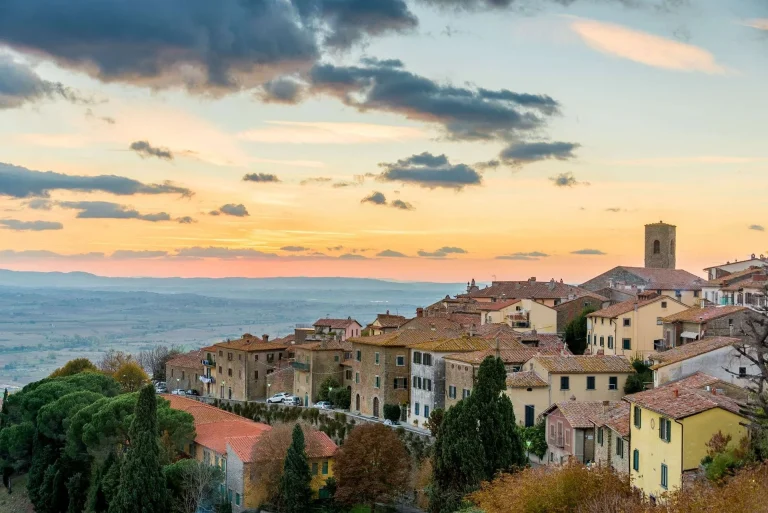
The route follows the upper ridge of the town, passing through sections where the walls are well preserved and impressive, through sections where they have been incorporated into later buildings and are visible only as a different texture in the stone, and through sections where the view over the Val di Chiana opens up in ways that explain immediately why the Etruscans chose this particular hill for their city.
The walk is not difficult but it is not flat. Cortona is a steep town and the walls follow its highest ridge. Comfortable shoes are important. The effort is modest and the reward is significant.
Starting point: The most accessible entry to the wall circuit is near the Fortezza Medicea at the top of the hill, reached by continuing uphill from the historic center past the upper residential neighborhoods.
Best time: Early morning, before the town is fully awake. The light is better, the temperature is cooler, and the sense of having the walls to yourself — which you likely will — is most complete.
Duration: Allow one to two hours for the full circuit, more if you want time to sit and absorb what you are looking at.
Cost: Free. No ticket. No booking. No opening hours.
The Walls in Context
The Etruscan walls are the most physically immediate way to connect with Cortona’s pre-Roman history, but they are part of a broader Etruscan landscape that rewards exploration.
The MAEC museum in the center of town provides the intellectual context — the artifacts, the history, the understanding of who built these walls and what their civilization looked like.
The Tumulo del Sodo — the great Etruscan burial mound just below the hill — provides a different kind of physical encounter with the same civilization: the interior of an Etruscan world rather than its exterior defenses.
Together, the walls, the museum, and the tombs constitute one of the most complete and accessible Etruscan experiences available anywhere in Italy — more intimate than the major sites in Lazio, less crowded than anything near Rome or Florence, and available in the context of a town that is beautiful and livable in its own right.
Experience the Etruscan Walls with MyTuscanDays
Context transforms experience. The walls are impressive on their own — with someone who understands their history, the political structure of the Etruscan League, the engineering of cyclopean masonry, and the human reality of the civilization that built them, they become something that stays with you for years.
MyTuscanDays offers private Cortona experiences that include the Etruscan walls as a central element — guided by Arpi, a local craftsman and insider who has spent years walking this town and learning its layers.
Every experience is private, personal, and built around your pace and your curiosity.
📍 Cortona, Tuscany, Italy 👉 Explore Experiences 👉 Reserve Your Day 📩 [email protected]