Hidden Cortona: The Neighborhoods Most Tourists Never Find
Every town in Italy has two versions of itself.
The first version is the one most visitors see — the main street, the central piazza, the famous viewpoint, the restaurants with menus in multiple languages and prices that reflect their location on the tourist circuit. This version is real. It is often genuinely beautiful. It is also, increasingly, the same in every beautiful Italian town.
The second version is the one that exists for the people who actually live there. The streets that go uphill past the point where most visitors turn back. The piazzas that have no cafes because they were never designed for people passing through. The fountains and staircases and doorways and views that are not in any guidebook because nobody thought to put them there — they are simply part of daily life for the people who live above them.
In Cortona, the distance between these two versions of the town is approximately two hundred meters of elevation and fifteen minutes of walking uphill.
Almost nobody makes the climb.
Hidden Cortona — Why Most Visitors Stay on Via Nazionale
Via Nazionale is Cortona’s main commercial street — a long, relatively flat road that runs through the center of the historic town connecting the main piazzas. It has good shops, decent cafes, reliable gelato, and the kind of pleasant Tuscan atmosphere that most visitors came to find.
It is also, for a significant portion of Cortona’s annual visitors, the entirety of their experience of the town.
This is understandable. Via Nazionale is where the obvious things are. It is where the tourist infrastructure is concentrated. It is flat, which matters when you have been traveling for a week and your feet hurt.
But Cortona is built on a steep hill, and Via Nazionale runs through approximately the middle of it. Below it, the town descends toward the parking areas and the modern outskirts. Above it, the town continues upward through a network of medieval streets that become progressively narrower, steeper, quieter, and more genuinely themselves the higher you go.
What You Find When You Go Up
The transition happens gradually. For the first few minutes above Via Nazionale, you are still in recognizable tourist territory — there are still occasional cafes, still the occasional shop, still other visitors making the same climb.
Then something changes.
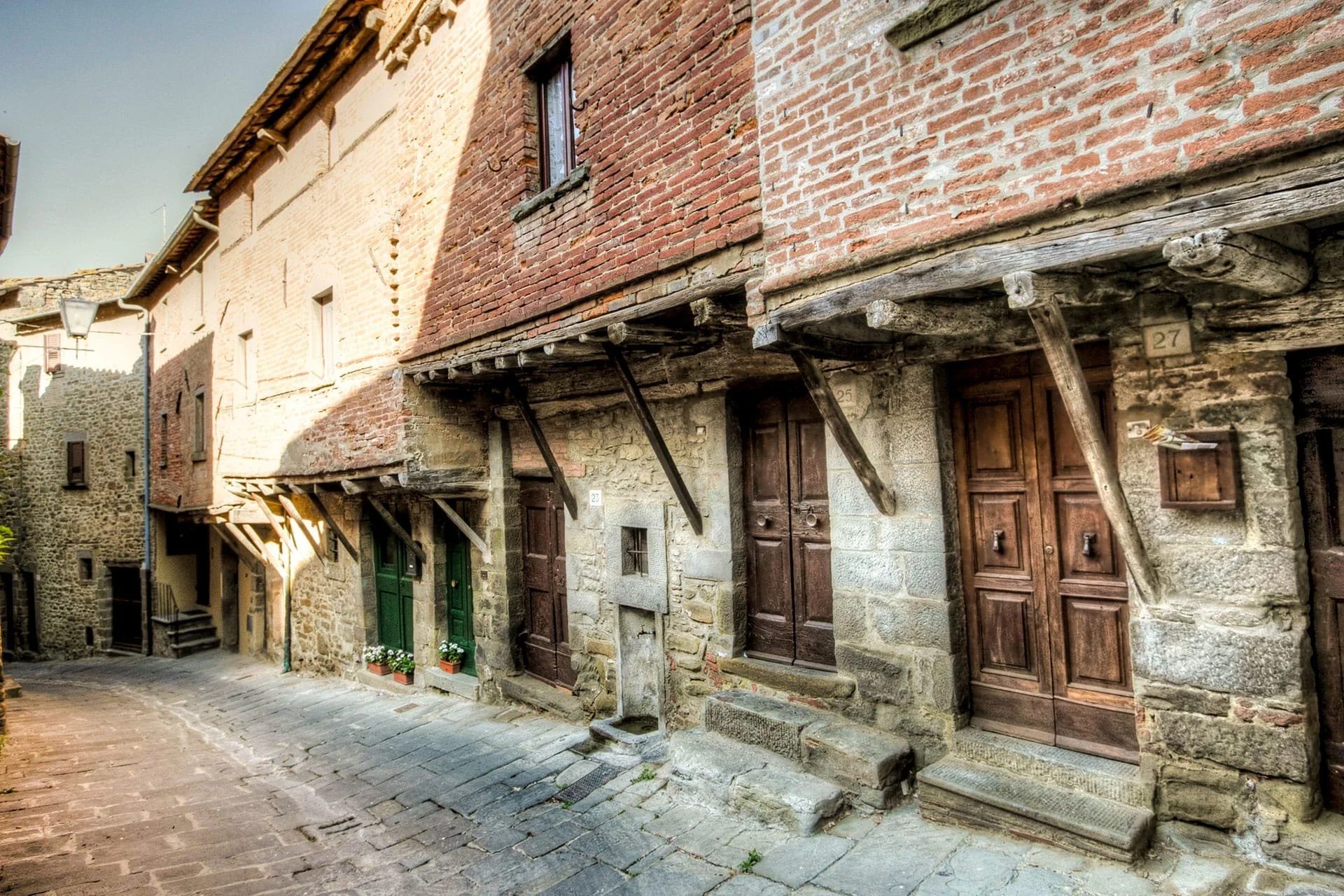
The streets narrow to the width of two people passing with care. The buildings lean toward each other overhead, close enough that in some sections you could touch both walls simultaneously. The stone underfoot becomes more uneven — these streets were not repaved for pedestrian comfort, they were simply kept in the same condition they have been in for centuries.
The sounds change. The ambient noise of the tourist town — the languages, the traffic, the general presence of large numbers of people — fades. What remains is quieter and more specific: a window being opened above you, a conversation in Italian from somewhere behind a door, a cat moving along a wall with the confidence of something that has never been asked to perform for anyone.
The upper piazzas — there are several small piazzas in the upper town that most visitors never reach. They have no cafes, no tourist infrastructure, no information panels explaining their historical significance. They exist because medieval urban planning required open spaces within the dense fabric of the town. They are used today by the residents of the surrounding buildings — as a place to park a bicycle, to let children play, to exchange a few words with a neighbor on the way somewhere else.
Sitting in one of these piazzas, you will almost certainly be the only visitor there. This is increasingly rare in Italian tourism and correspondingly valuable.
The external staircases — throughout the upper town, external stone staircases rise from street level to doorways on upper floors. Many of these staircases are original medieval construction — the stone worn smooth and slightly concave from centuries of feet. They lead to unmarked doors with no names, no numbers, no indication of what is behind them beyond the evidence of continued habitation: a pot of geraniums, a pair of shoes, the sound of a television.
The upper fountain — in the highest residential section of the town, there is a working fountain that still runs with cold spring water. It has been there, in various forms, for centuries — a functional water source for the households around it long before running water reached individual homes. Today it runs continuously and unvisited, the water cold enough to drink, the stone basin green with moss.
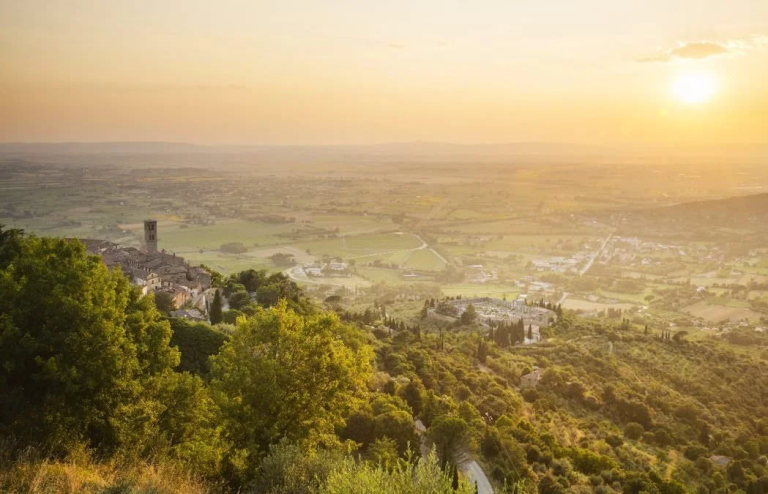
The views that nobody photographs — the famous views of Cortona — the ones on the postcards and travel blogs — are taken from specific, well-known viewpoints. The upper town has views that are equal to or better than these, available from points that require only that you keep walking uphill. Because they are not on any itinerary, you will almost always have them to yourself.
The Fortezza Medicea
At the very top of the hill, above the upper residential neighborhoods, sits the Fortezza Medicea — a Renaissance fortress built by the Medici in the 16th century on the foundations of much older fortifications.
The fortress itself is not always open for interior visits, but the area around it is accessible and provides the highest and widest panoramic views available from any point in or near Cortona. On clear days — most common in late autumn and early spring — you can see Lake Trasimeno to the south, the full breadth of the Val di Chiana below, and the hills of Umbria beyond.
This view is approximately twenty minutes of uphill walking from the center of Via Nazionale. Most visitors to Cortona never see it.
The Medieval Quarter Above Piazza della Repubblica
One of the most rewarding sections of the upper town lies in the medieval quarter immediately above and to the north of Piazza della Repubblica. This area was densely built during the medieval period and has changed relatively little since.
The streets here are not picturesque in the managed, photographable way of Italian towns that have been developed for tourism. They are picturesque in the way that things are beautiful when they have been used continuously for seven hundred years and nobody has thought it necessary to restore or reconstruct them for anyone’s benefit.
The walls show the repairs of multiple centuries — stone from different periods, different colors, fitted together by successive generations of residents maintaining what existed rather than replacing it. Windows have been opened and closed over the centuries as needs changed, leaving traces of earlier configurations in the stonework. A doorway that was bricked up two hundred years ago is still visible as a slightly different texture in the wall.
This is what medieval urban fabric actually looks like when it survives. Not a reconstruction. Not a preservation project. Simply a place that has been continuously inhabited and maintained by the people who live in it.
How to Explore the Upper Town
The upper town rewards wandering more than it rewards planning. There are no must-see attractions with opening hours and entrance fees — there is simply the town itself, available to anyone willing to walk uphill and pay attention.
Practical suggestions:
Go in the morning, before 10am — the light is better, the temperature is cooler for climbing, and the upper town is at its quietest.
Wear shoes with grip — the stone streets are uneven and can be slippery when wet.
Leave your itinerary behind — the upper town does not accommodate schedules. Let yourself get lost. You cannot get seriously lost in a town this size, and the getting lost is frequently the best part.
Bring water — there are no cafes in the upper town, but there is the fountain.
Go slowly — the upper town rewards attention. The details are in the stone, in the doors, in the small evidence of continuous habitation that accumulates when you are not rushing toward something.
Experience Hidden Cortona with MyTuscanDays
The upper town is one of the central elements of the Cortona experiences we offer at MyTuscanDays. Not as a guided tour with a microphone and a flag — but as a walk through a neighborhood with someone who has spent years learning its stories, its details, and the things that are not visible unless you know where to look.
There is a difference between walking through a place and understanding what you are walking through. MyTuscanDays provides the second experience.
Every experience is private, personal, and built around your pace and your curiosity.
📍 Cortona, Tuscany, Italy 👉 Explore Experiences 👉 Reserve Your Day 📩 [email protected]