Lake Trasimeno from Cortona — A View Worth the Walk
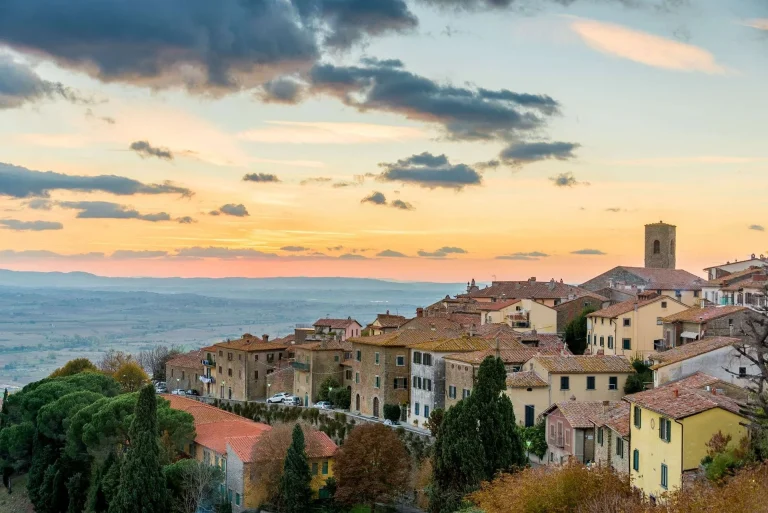
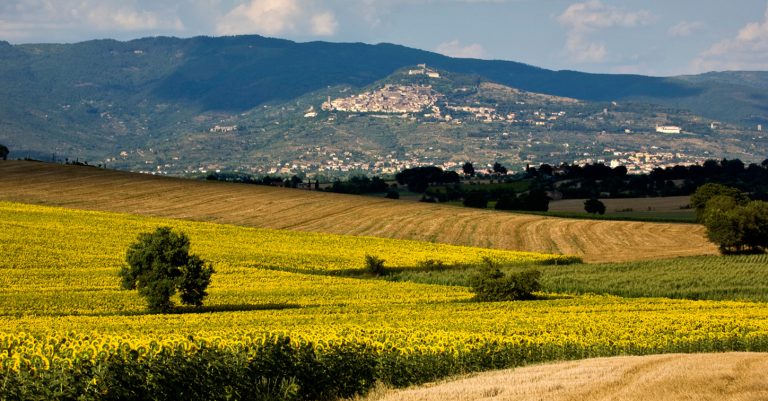
On clear days — most common in late autumn and early spring, when the atmosphere above the Val di Chiana is at its most transparent — a silver shape appears on the southern horizon from the Etruscan walls of Cortona.
Lake Trasimeno.
The largest lake in central Italy. The fourth largest in the country. Sitting on the border between Tuscany and Umbria, technically in Umbrian territory but visible from Cortona as a consistent presence on the southern horizon — a reminder that this hilltop was always positioned at the edge of things, looking out over more than one region, occupying a strategic point in the geography of central Italy.
The view of Lake Trasimeno from Cortona is not the primary reason to climb to the Etruscan walls. The walls themselves are the primary reason. But the lake on the horizon adds something to the view that changes its character — a sense of distance and depth, a landmark that anchors the eye and gives the landscape scale, a reminder that what you are looking at extends far beyond what you can immediately see.
The History That Surrounds the Lake
Lake Trasimeno is not simply a beautiful body of water. It is one of the most historically significant landscapes in European military history.
In 217 BC — two years after Hannibal crossed the Alps with his army and elephants and invaded Italy from the north — a Roman army of approximately 30,000 men marched along the northern shore of Lake Trasimeno in pursuit of the Carthaginian forces.
Hannibal was waiting for them. He had positioned his troops in the hills above the lake road — hidden in the early morning mist, arranged in a semicircle that would close around the Roman column as it advanced. The trap closed before the Romans understood what was happening. The battle lasted three hours. Approximately 15,000 Roman soldiers were killed.
It was the largest ambush in military history and the greatest Roman defeat before Cannae the following year. The casualties were so numerous that their blood, according to ancient accounts, temporarily discolored the waters of the lake.
The battle transformed the strategic situation in Italy and very nearly ended the Roman Republic. If Hannibal had marched on Rome immediately after Trasimeno, instead of waiting — a decision that has puzzled military historians for two thousand years — the history of Western civilization would have been different in ways that are impossible to calculate.
From the Etruscan walls of Cortona, looking south toward the lake on a clear day, you are looking at the landscape of this battle. The hills where Hannibal’s forces waited are visible. The flat northern shore of the lake where the Roman column advanced is visible. The morning mist that concealed the ambush still forms over the lake on autumn mornings.
History, in this landscape, is not a past event. It is geography you can see.
The Lake Itself
Setting aside the military history — which is significant but not the only thing worth knowing about Lake Trasimeno — the lake is a body of considerable natural beauty and ecological interest.
It is shallow for its size — the average depth is less than five meters — which makes it sensitive to seasonal variation and gives it a specific character in different weather conditions. In calm weather it is nearly mirror-flat, reflecting the sky and the hills around it. In wind it becomes textured and dark. In the late afternoon, when the light comes in from the west, the surface turns silver in a way that is visible from Cortona’s walls even at a distance of twenty kilometers.
The lake has three islands — Maggiore, Minore, and Polvese — each with its own character and history. Maggiore has a permanent population and is accessible by regular ferry service from Passignano sul Trasimeno. Minore is private. Polvese is the largest and contains the ruins of a medieval fortress and monastery, now converted to a park and environmental education center.
The towns around the lake — Passignano, Tuoro, Castiglione del Lago — are pleasant without being remarkable, the kind of Italian lakeside towns that sustain themselves through summer tourism and local commerce and have the comfortable unpretentiousness of places that have never been required to perform for visitors.
The Border — Tuscany and Umbria
Lake Trasimeno sits precisely on the border between Tuscany and Umbria. From Cortona, you are in Tuscany looking south into Umbria — or at the point where the two regions meet, which is not quite either.
This border has a long history. In Etruscan times, the territory around the lake was contested between the northern Etruscan cities — including Cortona — and the populations to the south. In the Roman period it was administrative. In the medieval period it became the frontier between Florence’s sphere of influence and that of the Papal States.
Today the border is administrative — it determines which regional government manages the road maintenance and which fire service responds to emergencies. But it is also cultural: Tuscany and Umbria are genuinely different in character, cuisine, and temperament, and the area around Lake Trasimeno exists in the meeting zone of these two characters.
For travelers based in Cortona, the lake is close enough to visit in an afternoon — forty-five minutes by car — and different enough from the Tuscan hill town experience to offer genuine contrast. An afternoon at Passignano, eating freshly caught lake fish at a waterfront restaurant, provides a specifically lakeside Italian experience that complements rather than duplicates what Cortona offers.
Lake Trasimeno from Cortona — How to Get There
The drive from Cortona to the northern shore of Lake Trasimeno takes approximately forty-five minutes by the most direct route — south from Cortona, descending to the Val di Chiana, crossing the valley floor, and climbing slightly into the Umbrian hills.
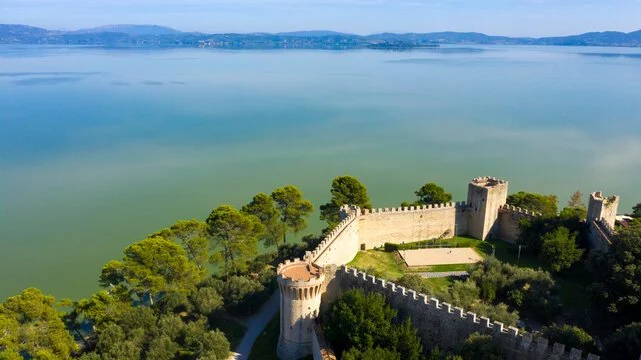
The lakeside towns of Passignano sul Trasimeno and Tuoro sul Trasimeno are the most accessible entry points. Castiglione del Lago, at the southwestern corner of the lake, requires an additional twenty minutes of driving but offers the finest views over the full extent of the water and a medieval fortress worth visiting.
Ferry services to Isola Maggiore depart from both Passignano and Tuoro — the crossing takes twenty to thirty minutes and the island can be walked in an hour. The island has one restaurant and several houses occupied by the small permanent population. It is a calm and unhurried place.
The View — When to See It
The view of Lake Trasimeno from Cortona’s Etruscan walls is weather-dependent. On hazy days — common in summer — the lake disappears into the atmospheric moisture over the valley. On clear days — most reliable in late autumn, winter, and early spring — it is immediately visible as a bright shape on the southern horizon.
The best view is from the highest accessible point of the walls, near the Fortezza Medicea. Face south. The lake is approximately twenty kilometers away. On the clearest days, the hills of Umbria beyond the lake are also visible.
Early morning — before the heat of the day creates atmospheric haze — is the best time. The lake in the early morning light, seen from 2,700-year-old walls above a town that has been watching this horizon since before Rome existed, is one of the quieter pleasures of spending time in Cortona.
Day Trip to Lake Trasimeno with MyTuscanDays
Lake Trasimeno makes an excellent afternoon addition to a Cortona day — or a standalone day trip with stops at the lakeside towns, a ferry to Isola Maggiore, and a fish lunch that is about as far from Florentine tourist food as it is possible to get while still being in central Italy.
MyTuscanDays can incorporate Lake Trasimeno into a private day experience from Cortona.
📍 Cortona, Tuscany, Italy 👉 Explore Experiences 👉 Reserve Your Day 📩 [email protected]