Francis of Assisi and the Hidden Hermitages of Tuscany
The story of Francis of Assisi is one of the best known in Christian history. The son of a wealthy cloth merchant in Umbria who gave away everything he had, founded an order of friars committed to radical poverty, preached to birds and negotiated with a wolf, received the stigmata on a mountain in the Apennines, and died at forty-four having changed the face of Western Christianity — this story has been told in thousands of books, painted in thousands of frescoes, filmed in dozens of films, and made Assisi one of the most visited pilgrimage sites in Europe.
What is less well known is the geography of his interior life — the specific places where the development that produced the Francis of history actually happened. The places where he was alone. Where he prayed before he was famous. Where the silence was deep enough to hear something.
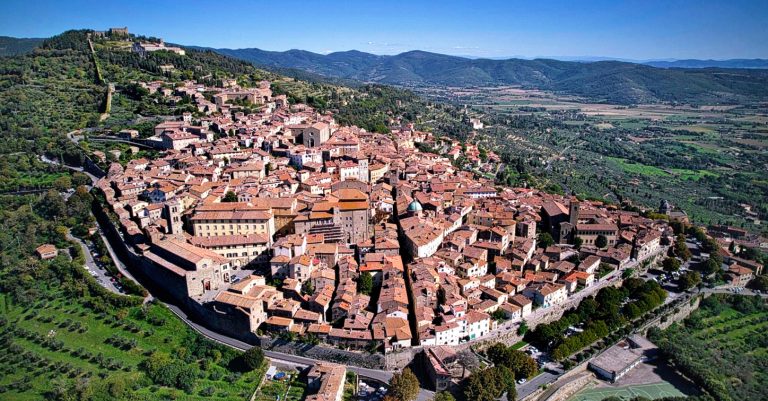
Several of these places are in Tuscany. The least known and most significant of them is Le Celle, near Cortona.
Le Celle — The Beginning
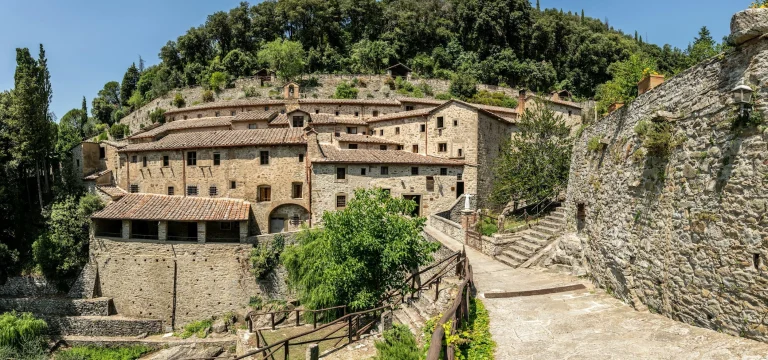
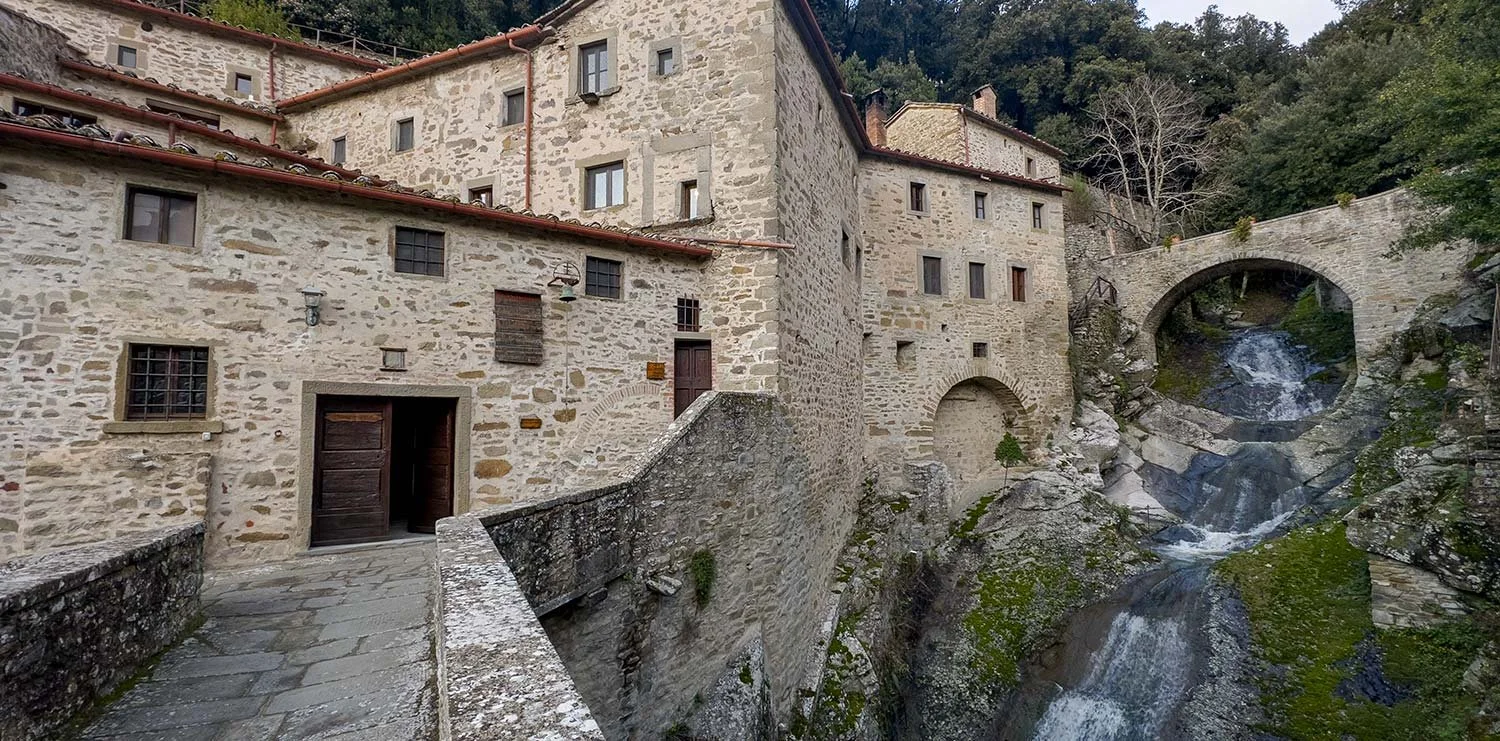
Le Celle is a hermitage located in a narrow ravine in the hills above Cortona — three kilometers from the town center, accessible by a short walk alongside a mountain stream that runs year-round with cold clear water.
The hermitage consists of cells carved directly into the cliff face of the ravine — small stone rooms with low doors and narrow windows, some of them barely large enough for a person to lie down in. A small chapel occupies a slightly larger space. The stream runs below, loud enough to be always present as a sound background.
Francis came here before he was anyone. Before the order was established, before the rules were written, before the thousands of followers who would join the movement he started had heard of him. He came here as a young man from Assisi who had given away his father’s cloth and his fine clothes and was trying to understand what he was supposed to do with the rest of his life.
The specific quality of Le Celle — the enclosure of the ravine, the constant sound of water, the complete removal from the noise and business of the towns below — gave him conditions for interior work that flat ground and open air could not.
He came back. Repeatedly. Throughout his life, as the order grew and the demands on him multiplied, he returned to Le Celle for the solitude it provided. The hermitage near Cortona was not simply a convenient retreat — it was a specific place with specific qualities that he sought out specifically.
The Friars Today
The most remarkable fact about Le Celle is not its history. It is that the hermitage is still in use.
Franciscan friars live at Le Celle today. Not as a heritage project or a museum function — as a vowed community living a life of prayer in a place that has been used for exactly that purpose for 800 years. The daily rhythm of the hermitage is essentially the same rhythm that Francis established: prayer at canonical hours, simple work, silence, more prayer.
The community is small — the hermitage can support only a limited number of friars, which is part of its character. The cells are the cells. The chapel is the chapel. The stream is the stream.
When you visit Le Celle, you are visiting an active monastery, not a preserved monument. This distinction matters enormously for the quality of the experience. The silence at Le Celle is not the managed silence of a heritage site. It is the silence of a place where people have been choosing silence, deliberately and consistently, for eight centuries.
The Other Franciscan Hermitages of Tuscany
Le Celle is the most significant Franciscan site in Tuscany but it is not the only one. Francis left traces across the region — places where he stayed, prayed, or established small communities during the years of his most intense activity.
La Verna: The mountain sanctuary in the Casentino forests, east of Arezzo, where Francis received the stigmata in 1224 — two years before his death. La Verna is the most famous of the Franciscan sites in Tuscany, significantly more visited than Le Celle, and a place of considerable natural beauty and spiritual power. The cliffs, the forests, and the altitude create a physical environment that explains immediately why Francis chose it for his most intense period of prayer.
Montecasale: A small hermitage near Sansepolcro, in the eastern part of Tuscany, where Francis stayed during his travels through the region. Less developed as a pilgrimage site than La Verna or Le Celle, it retains a rawness and simplicity that more famous sites sometimes lose.
Cerbaiolo: An even smaller hermitage in the hills of eastern Tuscany, associated with the early Franciscan movement and still maintained by a small community. Rarely visited, genuinely remote.
The Franciscan Geography — A Pilgrimage Route
The Franciscan sites of Tuscany and Umbria form a natural pilgrimage geography — a network of places that trace the physical movement of one of the most significant spiritual figures in Christian history across the landscape of central Italy.
A pilgrimage that begins at Le Celle near Cortona and ends at Assisi, passing through La Verna, can be completed in three to four days on foot following sections of the Via di Francesco — the marked pilgrimage route that connects the major Franciscan sites across the region. By car, the same route can be completed in a day with stops at the major sites.
This route passes through some of the most beautiful landscape in central Italy — the Casentino forests, the upper Tiber valley, the hills of Umbria approaching Assisi. The landscape itself, as much as the specific sites, explains something about why Francis found this territory spiritually productive. The forests, the mountains, the rivers — the natural world that he preached to and about — is still present, still wild in places, still offering the contact with creation that was central to his spirituality.
Visiting Le Celle — Practical Information
Le Celle is located three kilometers from the center of Cortona. The drive takes approximately ten minutes. You park at the bottom of the access road and walk up a short path alongside the stream to reach the hermitage — five to ten minutes of easy walking on a good path.
There is no entrance fee. The hermitage is open to visitors during daylight hours. Dress modestly — covered shoulders and knees out of respect for the active religious community.
The chapel can be entered. The cells along the cliff face can be viewed from the path, and some can be entered. The cave associated specifically with Francis’s prayer is identifiable — ask one of the friars if you are uncertain which one.
Photography is permitted in the exterior areas. Inside the chapel, follow local convention.
The stream alongside the path is worth the attention it asks. It runs year-round. The sound of it is one of the consistent features of the hermitage experience — present in every account, every description, every visit. Francis heard it. The friars hear it today. You will hear it too.
Sit by it for a while before you leave.
Experience Le Celle with MyTuscanDays
Le Celle is one of the places that MyTuscanDays includes in Cortona experiences — not as a scheduled attraction but as a place that deserves time and context.
If you want to visit Le Celle and understand what you are standing in — the history, the spirituality, the specific significance of this hermitage within the Franciscan tradition — we can build a day around it.
📍 Cortona, Tuscany, Italy 👉 Explore Experiences 👉 Reserve Your Day 📩 [email protected]