Tuscany Beyond Florence — Where to Go Instead
Florence is not the problem. Florence is extraordinary — one of the densest concentrations of human artistic achievement in the world, a city that justifies every superlative applied to it and earns every visit it receives.
The problem is what Florence does to a Tuscany trip when it becomes the entire Tuscany trip.
Most visitors to Tuscany spend the majority of their time in Florence, make one or two day trips to nearby towns — Siena, San Gimignano, Pisa — and return home having seen an extraordinary city and a narrow corridor of the region surrounding it. They go home saying they have been to Tuscany. In the strictest geographical sense, they have. In the sense that matters — in the sense of having understood what Tuscany actually is — they have been to one room of a very large house.
The rest of the house is where the best of it lives.
Why Tuscany Is Bigger Than You Think
Tuscany is the sixth largest region in Italy — 23,000 square kilometers of landscape that ranges from the marble mountains of Carrara in the north to the volcanic hills of the Maremma in the south, from the densely urbanized Arno valley in the center to the almost completely empty Crete Senesi in the southeast.
Within this landscape, there are at least six distinct Tuscanies — each with its own character, its own cuisine, its own wine, its own relationship with the history that has unfolded across this terrain over three millennia. Florence knows one of them well. The others are essentially independent countries by comparison.
The distances are not large. From Florence to Cortona is one hour and twenty minutes by train. From Cortona to Montepulciano is forty minutes by car. From Montepulciano to the Val d’Orcia is twenty minutes. The entire southern Tuscany that most visitors never see is accessible in a single day from Florence and comprehensible in three.
What it requires is the decision to go.
Cortona — The Hilltop Town That Does Not Perform
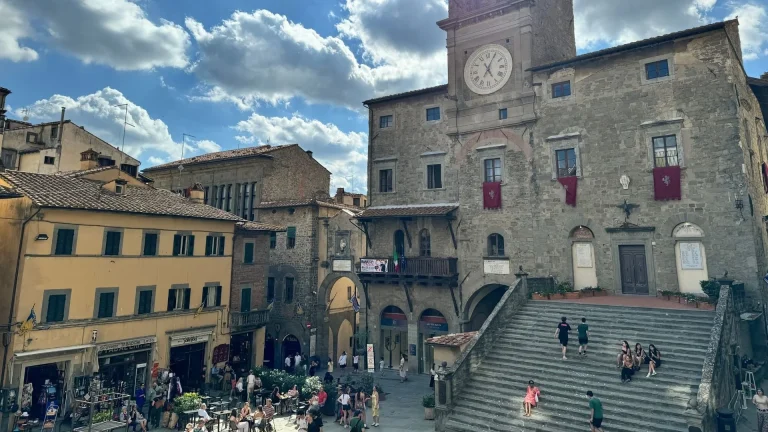
Cortona sits on a hill above the Val di Chiana in the far southeast of Tuscany, close enough to the Umbrian border that the landscape and the light have a slightly different quality from the Chianti hills to the north.
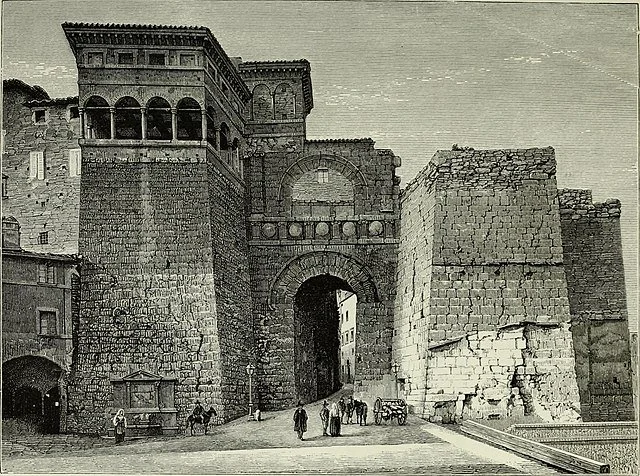
It is one of the twelve great cities of the Etruscan League — older than Rome, still encircled by walls built 2,700 years ago that you can touch with your hands today, no ticket required. Frances Mayes wrote her memoir here. The Saturday market has been happening in roughly this form for centuries.
What Cortona does not do is perform for visitors. The main street is pleasant. The upper town — the medieval neighborhoods above Via Nazionale that most visitors never reach — is where the town actually lives. The passeggiata happens every evening at 7pm whether tourists are watching or not. The trattoria where the locals eat does not have a menu in English.
This absence of performance is increasingly rare in Italian tourism and correspondingly valuable. Cortona is still genuinely itself.
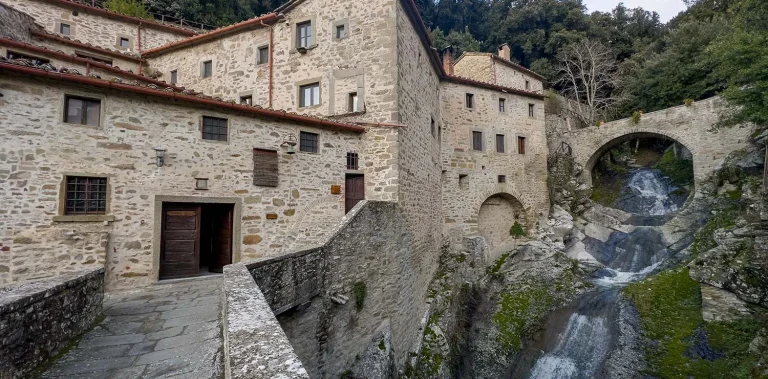
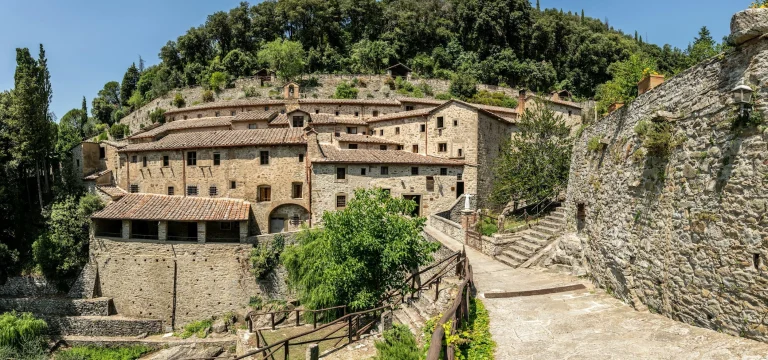
What to do: Walk the Etruscan walls at sunrise. Visit Le Celle — the Franciscan hermitage 10 minutes from town where Francis of Assisi prayed before Assisi became famous. Eat where the locals eat. Watch the passeggiata. Spend at least one full day.
Montepulciano — Where Italy’s Greatest Wine Is Made
Montepulciano is a hilltop town in southern Tuscany that organizes its entire existence around a single obsession: Vino Nobile di Montepulciano, a DOCG wine that has been produced in these hills since at least the 8th century and that the poet Francesco Redi called the king of all wines in 1685.
The cantinas — the wine cellars carved into the tufa rock beneath the medieval buildings — are the reason to come. The Contucci cantina has been in operation since the 15th century. The barrel rooms, the vaulted ceilings, the wine aging in enormous Slavonian oak casks — this is not a winery built for tourism. It is simply what it has always been.
The town itself is beautiful in the way that all southern Tuscan hilltop towns are beautiful — the architecture, the views, the proportions of the streets and piazzas — but the wine is the specific argument for making the trip rather than going somewhere more famous.
What to do: Arrive before noon. Taste in the cantinas through the morning. Eat lunch — pici with wild boar, bistecca from Chianina cattle raised in the valley below. Drive back through the Val di Chiana at golden hour.
Val d’Orcia — The Landscape That Defined Tuscany
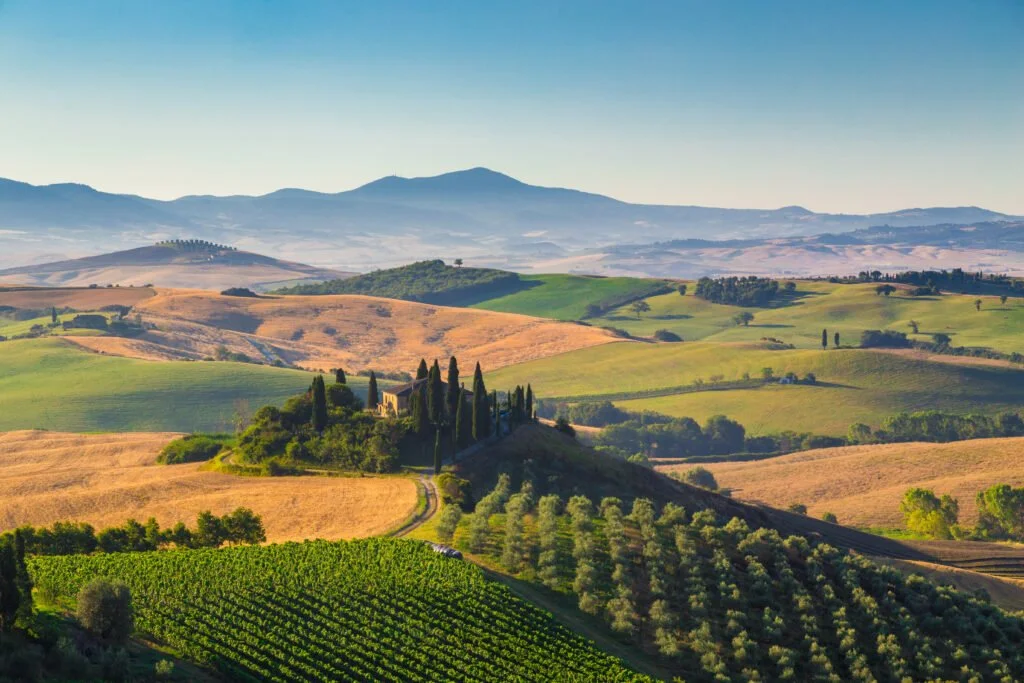
The Val d’Orcia is a UNESCO World Heritage landscape in south-central Tuscany — a valley of rolling clay hills, isolated farmhouses, cypress-lined roads, and a quality of light that has been attracting painters since the Renaissance and photographers since the invention of the medium.
This is the Tuscany of the postcards. The cypress avenue at San Quirico d’Orcia, the Gladiator road, the isolated farmhouse on the hill that appears in more stock photo libraries than any other building in Italy — all of these are real, and they are genuinely as beautiful as the images suggest.
The challenge with the Val d’Orcia is that its fame has made certain parts of it extremely crowded at certain times of year. The solution is timing — early morning in spring or autumn, when the light is at its most extraordinary and the crowds have not yet arrived — and knowledge of which parts of the valley are photographed by everyone and which parts are equally beautiful and completely empty.
What to do: Drive the back roads rather than the SP146 that everyone uses. Pienza for the view and the pecorino. Bagno Vignoni for the thermal pool in the center of the village. Montalcino for Brunello. Stay overnight if you can — the valley at dawn, before anyone else is moving, is the best version of it.
The Crete Senesi — Tuscany’s Empty Quarter
South of Siena, between the city and the Val d’Orcia, lies a landscape that almost no international visitors ever see: the Crete Senesi, the clay hills of the Sienese.
This is not landscape that photographs dramatically. It is too empty, too minimal, too dependent on the specific quality of light at specific hours to translate well into images. In person, particularly in late winter and early spring when the clay hills are bare and the light is horizontal and the colors range from grey to gold to deep amber, it is one of the most haunting landscapes in Italy.
There are no major tourist attractions in the Crete Senesi. There are small medieval towns — Asciano, Rapolano Terme, Murlo — that see a fraction of the visitors that better-known towns receive. There are abbey complexes — Monte Oliveto Maggiore, with its extraordinary frescoes by Luca Signorelli and Il Sodoma — that are genuinely significant and genuinely uncrowded.
This is the Tuscany that exists when you drive past the obvious and into the merely beautiful.
What to do: Drive without a specific destination. Stop when something demands it. Eat in whatever town you happen to be in at lunch. Accept that this landscape rewards patience and penalizes rushing.
The Maremma — Tuscany’s Wild South
The Maremma is the coastal and inland zone of southern Tuscany — a region that spent most of its history as malarial marshland, was drained and reclaimed in the 18th and 19th centuries, and has since developed into one of the most distinctive and least visited parts of the region.
The Parco Regionale della Maremma — the Maremma Natural Park — protects a stretch of coastline and inland territory that contains wild horses, white Maremma cattle, medieval watchtowers, and beaches accessible only on foot. The towns of the inland Maremma — Pitigliano, Sovana, Sorano — are built on volcanic tufa cliffs above river valleys and contain Etruscan tomb complexes that rival anything in Lazio.
The Maremma wine zone — Morellino di Scansano — produces Sangiovese-based wines with a character distinctly different from Chianti or Vino Nobile. The food is wilder, more rooted in hunting and pastoral traditions, less refined and more honest than the better-known Tuscan cuisines to the north.
What to do: Drive the Via Aurelia along the coast. Walk into the Maremma park from Alberese. Visit Pitigliano at sunset when the volcanic tufa glows. Eat at a place that serves cinghiale — wild boar — in one of the inland towns.
How to Plan a Tuscany Trip That Goes Beyond Florence
The practical framework for a Tuscany trip that reaches the places described above is straightforward.
Base yourself outside Florence. Cortona, Montepulciano, Pienza, or Montalcino are all viable bases for exploring southern Tuscany. Each has accommodation ranging from basic to very good. Each is within an hour of several other significant destinations. None of them require you to navigate Florentine traffic.
Allow more days than you think you need. Southern Tuscany is not a checklist. It is a landscape that rewards staying in one place long enough for the place to reveal itself. Three days in one town is more valuable than three days covering six towns.
Use a local guide for at least one day. The difference between driving through a landscape and understanding what you are driving through is the difference between Florence-only Tuscany and the real thing. One day with someone who lives in the region recalibrates everything.
Experience Tuscany Beyond Florence with MyTuscanDays
MyTuscanDays offers private day experiences from Cortona into southern Tuscany — Montepulciano, the Val d’Orcia, the Crete Senesi, the Etruscan sites, and the landscape between them — guided by someone who actually lives here and has been exploring this territory for years.
Every experience is private, personal, and built around your interests and pace.
📍 Cortona, Tuscany, Italy 👉 Explore Experiences 👉 Reserve Your Day 📩 [email protected]
Tuscany Beyond FlorenceHidden TuscanyTuscany TravelCortonaMontepulcianoVal d’OrciaMyTuscanDaysBest of TuscanySlow Travel ItalySouthern Tuscany