
The Etruscan Trail in Cortona — A Guide to Ancient Tuscany
Before Rome existed, Cortona was already ancient.
One of the twelve sacred cities of the Etruscan League, Cortona holds some of the most accessible and least crowded Etruscan sites in all of Italy. Here is how to experience them.
Most people's knowledge of ancient Italy begins with Rome. The Colosseum. The Forum. Caesar. The legions. It is a compelling story — but it starts in the middle.
Before Rome was an empire, before Rome was a republic, before Rome was even a small city on seven hills, there was a civilization that stretched across central Italy for centuries. They built cities, traded across the Mediterranean, created extraordinary art, and developed a religious system so sophisticated that the Romans absorbed it almost entirely.
They were the Etruscans. And Cortona was one of their most sacred cities.
Who Were the Etruscans?
The Etruscans remain one of the great mysteries of the ancient world. Their origins are still debated by historians — some argue they were indigenous to Italy, others that they migrated from Anatolia, others still that they developed independently from earlier Italian cultures. Their language is only partially understood, despite decades of scholarly effort.
What is not mysterious is their achievement. Between approximately 900 BC and 200 BC, the Etruscans built a network of city-states across central Italy — modern Tuscany, Umbria, and Lazio — that were among the most sophisticated urban centers of their time. They had drainage systems, paved roads, and monumental architecture. Their metalwork was traded as far as Greece and the Middle East. Their funerary art is among the most extraordinary in the ancient world.
The twelve great cities of the Etruscan League — the dodecapoli — were the political and religious centers of this civilization. Cortona was one of them.
When Rome eventually absorbed the Etruscan cities, it did not erase what came before. It built on top of it. The religious practices, the architectural techniques, the urban planning principles that define Roman civilization owe an enormous debt to the Etruscans who came first.
In Cortona, that debt is visible everywhere. You just have to know where to look.
The Etruscan Walls — Touch 2,700 Years of History
The most immediate and physical connection to Cortona's Etruscan past is the city walls.
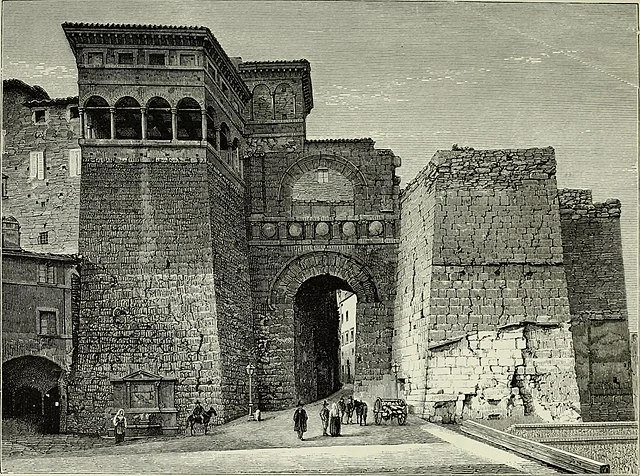
Running along the upper ridge of the hill, sections of the original Etruscan walls are still standing — massive irregular stones fitted together without mortar in a construction technique called cyclopean masonry. The name comes from later civilizations who found these walls and assumed, given the size of the stones, that they must have been built by giants.
The stones range from large to truly enormous. They fit together with a precision that seems impossible without modern tools and was clearly achieved through patience, skill, and deep understanding of the material. Some sections have been reinforced or rebuilt in later centuries — Roman, medieval, Renaissance — but the Etruscan foundation is still there, still carrying the weight of everything built on top of it.
You can walk the full surviving length of the walls. You can put both hands flat on the stone. You can press your face against rock that was placed there 2,700 years ago.
No ticket required. No opening hours. Just history, completely available.
Practical information: The best-preserved sections of the Etruscan walls are accessible from the upper part of the historic center, near the Fortezza Medicea at the top of the hill. A walk along the walls takes approximately 45 minutes at a comfortable pace and provides some of the finest views over the Val di Chiana available anywhere in Tuscany.
The Tumulo del Sodo — Inside an Etruscan Tomb
Just below Cortona, on the flat agricultural land at the foot of the hill, lies one of the most remarkable and least-visited Etruscan archaeological sites in Italy — the Tumulo del Sodo.
A tumulus is a burial mound — a large circular earthwork covering one or more burial chambers. The Tumulo del Sodo is one of the finest examples in Tuscany, containing multiple chambers and a monumental external altar with carved figures and a grand stone staircase that descends into the burial complex.
The care and sophistication of the construction tells you everything about Etruscan attitudes toward death and the afterlife. For the Etruscans, death was not an ending but a continuation. The burial chambers were furnished with everything the deceased would need — food, wine, jewelry, weapons, household objects. The quality and quantity of these goods reflected the status of the person buried and the resources of the family.
The carved altar on the exterior of the Tumulo del Sodo is particularly extraordinary — a monumental structure with figurative sculpture that archaeologists are still working to fully interpret. It is one of the most significant Etruscan discoveries of the 20th century, excavated in the 1990s after remaining hidden underground for over two thousand years.
Practical information: The Tumulo del Sodo is located approximately 1.5 kilometers from the center of Cortona, easily reachable on foot or by car. Opening hours vary seasonally — check locally before visiting. Entrance fee applies.
The MAEC Museum — The Finest Etruscan Collection in Southern Tuscany
For the full context of what you are seeing on the walls and at the tombs, the MAEC — Museo dell'Accademia Etrusca e della Città di Cortona — is essential.
Located in the Palazzo Casali in the center of Cortona, the MAEC holds one of the most significant collections of Etruscan artifacts in Italy. The collection includes bronze objects, funerary urns, jewelry, household items, and the famous Etruscan chandelier — a large bronze lamp dating from the 5th century BC that is one of the masterpieces of Etruscan metalwork.
The museum also documents the later history of Cortona through the Roman, medieval, and Renaissance periods — providing a continuous narrative of a city that has been continuously inhabited for nearly three thousand years.
What makes the MAEC particularly valuable is the context it provides for the physical sites. After walking the Etruscan walls and visiting the Tumulo del Sodo, the objects in the museum connect the physical experience to the human reality behind it — the people who made these things, used them, valued them enough to bury them with their dead.
Practical information: The MAEC is located in Piazza Signorelli, in the center of Cortona. Open year-round with varying seasonal hours. Entrance fee applies. No advance booking required.
The Melone del Sodo — A Second Tumulus
Less well known than the Tumulo del Sodo, the Melone del Sodo is a second Etruscan burial mound located nearby. Less extensively excavated and less frequently visited, it provides a rawer, less curated experience of Etruscan archaeology — more of the sense of discovery that the original excavators must have felt.
For visitors with a serious interest in Etruscan history, the Melone provides a valuable complement to the more developed Tumulo site.
Walking the Etruscan Trail — A Suggested Route
The following route covers the main Etruscan sites in and around Cortona in a single day. It can be done independently or with a private guide who can provide the historical context that makes the physical sites fully comprehensible.
Morning: Begin at the MAEC museum when it opens. Allow two hours for a thorough visit. This provides the intellectual framework for everything you will see during the rest of the day.
Late morning: Walk from the museum up through the historic center to the Etruscan walls. Follow the walls along the ridge toward the Fortezza Medicea. The views over the valley become progressively more extraordinary as you climb. Allow 1-1.5 hours.
Lunch: Return to the center for lunch. Cortona has several excellent options within five minutes of the main piazza. Allow two hours — this is Tuscany.
Afternoon: Drive or walk down to the Tumulo del Sodo. Allow 1-1.5 hours for a thorough visit including the external altar and the burial chambers. If time and energy permit, continue to the Melone del Sodo.
Late afternoon: Return to Cortona for the passeggiata — the evening walk through the town that has been a daily ritual here for centuries. Finish with aperitivo in Piazza della Repubblica as the light over the valley turns amber.
This is a full day. It is one of the best days available anywhere in Tuscany.
Experience the Etruscan Trail with MyTuscanDays
Context transforms experience. The Etruscan walls are impressive on their own — with someone who knows their history, the political structure of the Etruscan League, the building techniques, and the civilization that created them, they become something that stays with you for years.
MyTuscanDays offers private Cortona and Tuscany experiences that include the Etruscan trail as a central element — guided by Arpi, a local craftsman and insider who has spent years studying and walking this landscape.
Every experience is private, personal, and built around your pace and your interests.
📍 Cortona, Tuscany, Italy 👉 Explore Experiences 👉 Reserve Your Day 📩 arpi@mytuscandays.com